A close look
at the OPP.
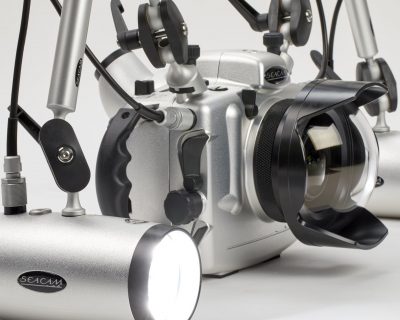
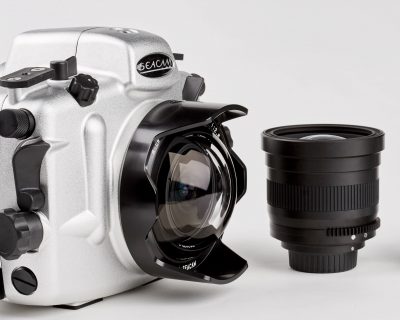
When underwater photographers talk about image quality, the conversation sooner or later almost always revolves around lenses, dome ports, and compromises. Wide-angle underwater photography is particularly demanding; even exceptional lenses that perform brilliantly in air can behave significantly differently underwater when paired with a front port. This is precisely where the SEACAM Optical Precision Port—or OPP for short—becomes interesting.
It was specifically engineered for wide-angle zoom lenses, with the goal of significantly improving underwater image quality while remaining smaller and lighter than traditional dome ports. The fundamental question of this test was therefore simple: Can the OPP truly outperform conventional front port solutions in practice?


Test Setup
To find out, the OPP was examined in a multi-phase test under controlled conditions and compared with other front port systems, most notably the company’s own SD Superdome and CP Compact Port. The results are not based on a few isolated shots or spontaneous impressions, but on a systematic series of comparisons under reproducible conditions. In a custom-built test tank, specially designed test charts were mounted on the walls and floor, including grid patterns, Siemens stars, resolution targets, and other optical test structures. This allowed sharpness, distortion, chromatic aberration, field curvature, and depth of field to be assessed consistently.
In Detail
At the heart of the test was the Nikon 16–35mm f/4, which served as the actual reference lens for the OPP. However, for broader context, it was equally important to consider other classic wide-angle lenses, such as Nikon’s 14–24mm, 18mm prime, 16mm fisheye, several Z‑mount zooms, and, above all, the native Nikonos RS underwater lenses like the RS 13mm, RS 20–35mm, and RS 28mm. Thus, the OPP was not only tested against standard dome port combinations, but also evaluated in relation to some of the most revered underwater optics ever made. In total, the test encompassed 105 camera/lens/port/focal length configurations, each evaluated across the full range of available aperture stops. This included the primary comparisons as well as dry reference shots and additional exploratory trials.
The work was carried out in two stages. First came a dry test, using the same setup but without water and without a front port. This established a useful reference point for how the lenses behaved in air. Then came the underwater test in fresh water, with identical camera positions, allowing the effect of the ports and the water itself to be judged more clearly. Throughout the test, exposure remained fully manual and consistent. In some comparisons, white balance and tonal values were adjusted in Lightroom to make dry and wet images more directly comparable in certain characteristics. In a few cases, profile-based or manual perspective corrections were also applied and clearly marked, solely to compare some end results under similar viewing conditions. The basis of the test, however, remained the original, untreated RAW files.
That last point matters because underwater imaging always involves some effects that are not actually lens defects. In the case of a wide-angle lens underwater looking at a flat measuring plane, brightness falls off more strongly toward the edges of the frame simply because the light from those outer image areas has to travel a longer path through water before reaching the lens. At first glance, this can look a little like vignetting, but it is really a property of the medium and the geometry rather than of the optics themselves. The test therefore tried to separate what belongs to the lens-port combination from what belongs to underwater photography itself.
Corner sharpness
The outcome was striking. With the Nikon 16–35 mm in the OPP, the overall performance was better than with the Superdome across all underwater-tested focal lengths from 16 to 35 mm. In the centre of the frame, the differences were often small. But toward the image edges, where underwater wide-angle systems typically begin to struggle, the OPP consistently showed an advantage. It delivered better edge sharpness, less chromatic aberration and, in most cases, lower distortion. At 24 mm, one minor qualification applies: distortion was essentially the same as with the Superdome, with the SD appearing at most marginally better. The OPP’s overall lead remained unaffected.
This is important because underwater photographers rarely judge a system by one single optical characteristic. A little less distortion at one focal length does not outweigh softer edges, more colour fringing or a generally weaker image. In overall image quality, the OPP proved to be the stronger solution. It also performed better than the Compact Port, and in direct comparisons the Nikon 16–35 mm in the OPP even surpassed the Nikon 14–24 mm in the Superdome at 16 mm and 24 mm. It also outperformed the AF-Nikkor 18 mm in the Superdome. For photographers who want a rectilinear wide-angle solution underwater, that is a significant result.
Depth of field
One of the most interesting findings concerned depth of field. Underwater photographers often think of ports mainly in terms of sharpness and distortion, but the OPP also influenced how much of the scene stayed acceptably sharp. In the depth-of-field tests, it showed advantages at several focus distances. Compared with the same Nikon 16–35 mm used in air, the OPP underwater actually produced greater practical depth of field. At first that seems counterintuitive, because the OPP also caused a slight reduction in angle of view underwater. But that narrower field, combined with a flatter and better-corrected plane of focus and reduced field curvature, appears to have allowed the zone of useful sharpness to extend farther into space. In real terms, that means the lens became not only cleaner at the edges, but also more forgiving in parts of the frame where underwater photographers often need extra depth.
At close range, things became more nuanced. The position of the sharpness zone could shift slightly rearward in the lateral parts of the frame, so it was not just the amount of depth of field that mattered, but also exactly where that sharpness sat in space. Even so, the OPP showed a very convincing behaviour overall, and at very small apertures it was possible to photograph objects extremely close to the front glass while still keeping them sharp. That kind of performance is particularly relevant for creative close-focus wide-angle work.
The test also looked at whether the results changed between cameras. The Nikon D850 served as the main reference body, but in some cases the Nikon Z8 was also used with the same lenses via adapter. Here the differences were very small. Image quality in the OPP was practically identical between the two cameras, with the Z8 appearing only minimally better at the very image edges in some cases, showing just slightly less chromatic aberration there, visible only at 200% magnification or higher. That difference was subtle enough that, for most photographers, it would not be a deciding factor. The Z8 with the NIKKOR Z 14–30 mm f/4 S also performed exceptionally well in the OPP, showing very high sharpness and the lowest chromatic aberration, with the trade-off of some pincushion distortion.
Surprises
Of course, any evaluation of underwater wide-angle optics eventually runs into the benchmark question: how close can a modern front-port system come to a native underwater lens? This is where the Nikonos RS lenses enter the story. These lenses were designed specifically for underwater use and remain legendary for good reason. As expected, the RS 13 mm in particular remained the reference standard. In centre detail it was sharper and cleaner than the OPP setup, and in direct comparison it still had the edge. The same was true when comparing the RS 13 mm with the Nikon 16 mm fisheye in a dome. Yet the surprise of the test was how close the OPP came. In some centre comparisons on the ISO chart, after perspective and comparison corrections, the OPP was nearly equivalent to the RS 13 mm, though still with more chromatic aberration. That is remarkable when one remembers that the OPP is being used with a rectilinear terrestrial zoom rather than a purpose-built underwater lens.
The RS 20–35 mm and RS 28 mm comparisons added more perspective. At comparable angles of view, the OPP often delivered very strong overall image quality, with competitive or better edge performance in several situations. The native RS lenses, however, still retained specific strengths, especially in maintaining rectilinear rendering and, in some cases, slightly higher sharpness. The overall picture was clear: the RS lenses remain the gold standard, but the OPP comes remarkably close.
Convincing Results
There were also some practical observations that matter beyond the charts. The Nikon 16–35 mm in the OPP behaved underwater much more like it did in air than many photographers would assume. Apart from a very small reduction in edge sharpness wide open, the overall rendering remained surprisingly close, especially from f/8 onward. By f/11 and f/16, the system reached a very high level of performance across most of the frame. That makes f/11 the most attractive all-round working aperture, with f/16 as an option when maximum depth of field is needed. At f/22, as one would expect, the image began to lose micro-contrast due to diffraction, so that setting is best reserved for special close-range situations rather than general shooting.
Using the Nikon 16–35 mm f/4 with the OPP, split-level shots without air-side vignetting became possible at 21 mm, whereas the same lens in the Superdome allowed this already from 16 mm onward. The trade-off – or, in certain situations, perhaps an interesting feature – is that the OPP then introduces a fisheye-like deformation in the upper air half of the frame.
Taken together, the results of this test make a compelling case. The Seacam Optical Precision Port proved to be not just a viable alternative to a large dome, but, with the Nikon 16–35 mm f/4, the best overall solution among the port systems tested here. It delivered excellent edge sharpness, low chromatic aberration, well-controlled distortion and impressive practical depth of field. It did so while being smaller than the Superdome, and while coming surprisingly close to the performance of native underwater optics that remain very difficult to match.
Conclusion
For ambitious underwater photographers, the main takeaway is refreshingly simple. If you want to shoot underwater with a rectilinear wide-angle zoom and demand the highest image quality right out to the edges, the OPP offers an unusually strong combination of sharpness, control and usability. It does not replace the legendary native underwater lenses, but it pushes the previous limits of what is achievable in underwater wide-angle photography: within the world of terrestrial lenses used behind underwater front ports, this test shows very clearly that it ranks among the most convincing optical solutions currently available.
→ Download the interactive Test Chart in Full Res (900MB)
Note: The interactive PDF is a large file – download time may vary.

Christoph
Gerigk.
Christoph Gerigk is among the most distinguished international underwater photographers. For over three decades, his work has seamlessly merged artistic underwater photography, scientific documentation, and experimental image production under the most demanding conditions. His hallmark projects include the iconic book Ghost Ships (Geisterschiffe), his long-standing tenure as the official photographer for the European Institute for Underwater Archaeology, and a high-resolution Underwater Digital Twin that brings an entire marine ecosystem to life in unprecedented scale and depth of detail. His work has been honored with two World Press Photo Awards.

The OPP
System.
The SEACAM OPP system brings the uncompromised imaging performance of your lenses beneath the surface. Look forward to flawlessly sharp image quality – packed into a compact design that takes up minimal space in your travel luggage. And thanks to its great buoyancy, your housing will float in your hands with effortless ease. Redefine your wide-angle photography and let us configure the perfectly tailored OPP system for your camera.